
Federal Release Routes
The BOP Inmate Locator covers federal inmates incarcerated from 1982 forward. It is the main public route for a sentenced federal prisoner. The U.S. Marshals Service has a different role. It takes custody after federal arrests, arranges detention and transport, and may place a person in a local, state, or private facility. USMS does not operate a public released-person locator comparable to BOP.
A person who vanishes from a local jail may have moved to another USMS contract bed, entered BOP custody after sentencing, or been released under a federal court order. None of those outcomes can be inferred from the local roster alone. For a sentenced person, use BOP. For a pretrial defendant, use the federal docket and order, then confirm with the actual housing jail.
| Custody stage | Release proof |
|---|---|
| Federal sentence | BOP locator and BOP record |
| Federal pretrial | Federal court order and housing facility |
| USMS movement | Housing facility and federal docket |
| Other-agency transfer | Receiving custodian |
Search Federal Release Records
Search BOP by Register, DCDC, FBI, or INS number when one is known. A name search accepts first, middle, and last name with optional race, age, and sex. Results can show the person’s name, register number, age, race, sex, release date, and location. BOP says locator data is extracted daily, so it is not a minute-by-minute movement log.
- Use the most precise federal number available.
- Match the full name and identity fields.
- Read the Release Date and Location together.
- Distinguish a past date from a future projection.
- Check another custodian if the result is unclear.
A past Release Date with no institution means, under the BOP record guide, that BOP custody ended that day. Location “RELEASED” also means no longer in BOP custody. Some displays use “Not in BOP Custody.” That status does not rule out supervision, a state hold, ICE custody, or another agency. “IN TRANSIT” is movement, not release. “UNKNOWN” means the term has not been determined.
Federal Search Gaps
No result can mean the person was never a BOP prisoner, the record predates 1982, or the search details do not match. It can also mean the person is in USMS pretrial custody rather than serving a BOP sentence. Older federal prison records may require the National Archives. More recent BOP information may require a federal records request with proof of identity or authorization where privacy rules apply.
For BOP locator correspondence, the research identifies Federal Bureau of Prisons, Attn: Inmate Locator, 320 First Street NW, Washington, DC 20534. A broader request may use FOIA and DOJ-361 where required. Ask for a defined release or movement record and include the register number if known.
USMS explains its role on the official custody and detention page. Because it uses other facilities, the jail that physically housed the defendant may hold the operational entry and exit times. The federal court supplies the legal release authority.
Knox Federal Custody Checks
An ordinary Knox County or Kentucky sentence will not appear merely because BOP is searched. Begin with the county jail for a Knox booking, KOOL for Kentucky corrections jurisdiction, and BOP only when the case is federal. The Knox County Detention Center release page explains the county path and why a transfer must be traced to its recipient.
If a federal defendant was housed in a local jail, record the exact housing facility and dates. Then match the federal docket’s detention, release, or commitment order. A local roster removal without that order can reflect transport. Once a sentence begins, BOP location and release fields become the better public path.
Supervised release is a federal court sentence served in the community after imprisonment. It is not the same as remaining inside BOP. A BOP “RELEASED” location answers the BOP-custody question, not every later court obligation.
Federal Release Evidence
Keep the status label exactly as displayed and note the date checked. Preserve whether the date was past or future and whether a location appeared. If two systems conflict, contact the office that created the record. BOP controls BOP data, the court controls its orders, and the housing jail controls its own movement record.
The official locator image below helps identify the correct federal interface. The BOP locator source should be opened directly before entering a name or number.
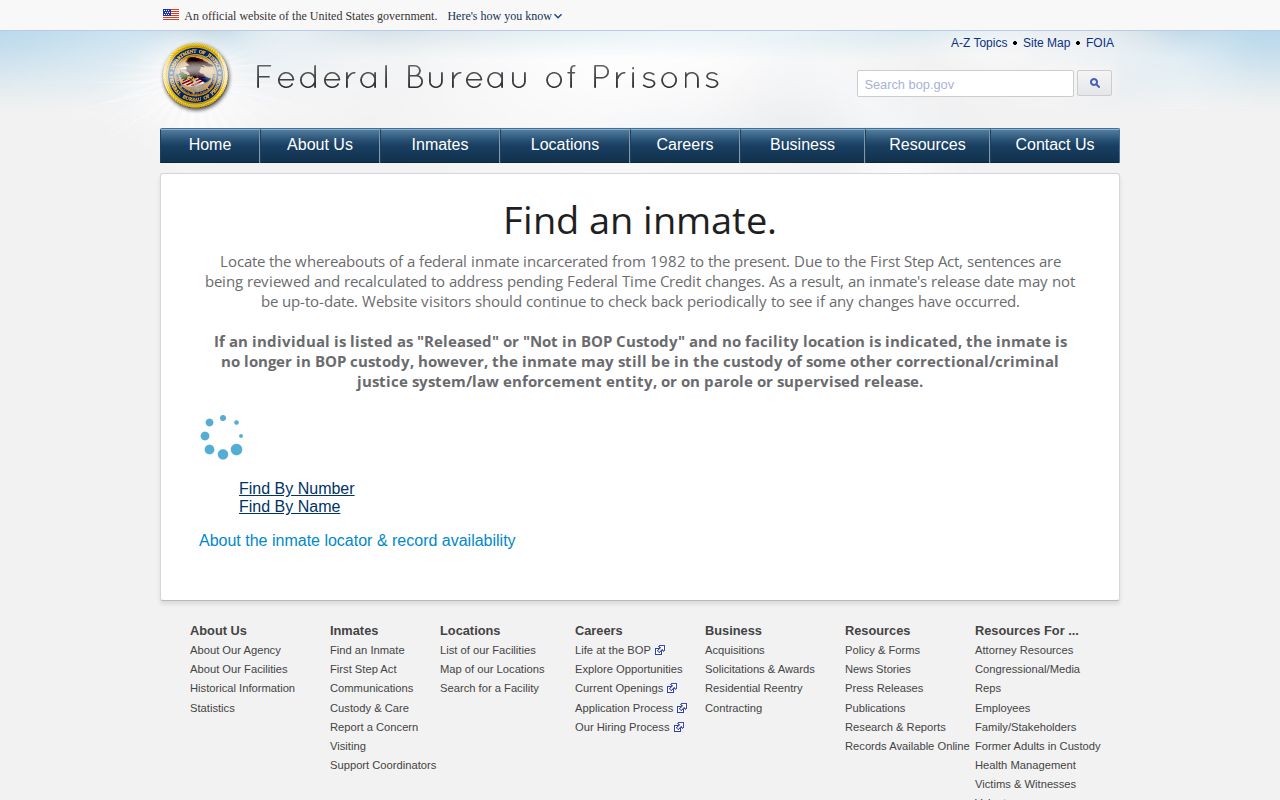
The captured page is a locator entry point, not proof that a particular Knox County person was released.
For county, state, and federal comparisons, use the Knox County released inmates search path. Keeping custodians separate prevents a transfer from being reported as freedom.
Federal Court Release Orders
A federal pretrial release is established by the federal court order, not by a BOP search. Compare the docket with the housing facility departure record because an order and physical exit need not occur at the same instant. Staff may still resolve identity, transport, or another lawful hold.
After sentencing, a commitment order can explain why USMS moved the person into BOP. If a local roster stops showing the name then, the event is a transfer. Search BOP after the movement reaches its daily data, and use the federal register number for an exact match.
The court explains authority and conditions. The housing facility records admission and departure. BOP reports sentenced-prisoner location and its release field. A sound federal release check keeps all three sources in their proper roles.
Federal Release Date Meanings
A future BOP date is a projection, not a promise. Calculations can change, including through First Step Act calculations. A past date paired with a released location shows that BOP custody ended, but says nothing by itself about later custody or federal supervised release.
Record the date the locator was checked. Daily extraction can create a gap between an operational change and the public display. If timing is crucial, use the court order and contact the responsible facility. When privacy rules limit disclosure, request only the defined record needed and provide authorization where required.
Older federal prison history may sit with the National Archives. A BOP no-result can also reflect a record before 1982, a name mismatch, or detention under USMS without a BOP sentence. Those alternatives deserve follow-up before any release conclusion.
Federal Release Follow-Up
When the locator shows release, save the register number, exact location label, release date, and date searched. If the person must prove the event, request the official BOP record rather than relying only on a screenshot. A court order may document conditions, while probation records may address federal supervised release.
When the person remains “IN TRANSIT,” wait for a destination update or contact the responsible federal channel. Do not call that status release. If the person was housed locally, the facility may confirm that the person departed without being able to disclose the next secure location. The federal docket can then help distinguish transport after sentencing from release by the court.
For older or disputed records, narrow the request to the person, register number, event, and date range. This reduces privacy conflicts and helps the custodian locate the proper movement or release entry.