
Understanding Knox County Released Inmates
“Released” identifies the end of one custodian's control, not necessarily the end of every legal obligation. The Knox County Detention Center may release a person into the community, but it may also transfer that person to Kentucky corrections, another jail, federal custody, or immigration custody. A court may authorize bond, dismissal, probation, shock probation, or time served. Kentucky corrections can record parole, mandatory reentry supervision, sentence expiration, or another state movement.
The official current-inmate list answers a narrow question: is a matching person listed in Knox custody now? A name that disappears may reflect release, transfer, correction, or another event. The enduring explanation usually comes from two records. The detention center's booking-and-release record documents what staff did and when. The Knox District or Circuit Court case documents the legal authority. State, VINE, and federal systems add custody-specific evidence when those agencies are involved.
Release terms. Bond permits departure while a case continues. Time served means credited custody satisfies the ordered term. Parole is conditional release decided by the Kentucky Parole Board. Probation is court-ordered community supervision. Discharge generally marks completion of the controlling correctional obligation. Transfer ends one facility's custody but is not community release.
How Knox County Custody Ends
The release type determines which record should be checked next. Knox's official bond information distinguishes recognizance, surety, unsecured, partially secured, and fully secured or property bonds. Some bonds are preset; others require a judge. Departure on bond does not decide guilt or end the criminal case. A sentence-expiration or time-served release has a different documentary basis, while a transfer means another agency assumed custody.
| Type | What it means | Best next record |
|---|---|---|
| Recognizance or bond | Detention ends while the court case continues. | Jail release entry and the bond order in the court case. |
| Dismissal or court order | A judge supplies authority to release, subject to other holds. | District or Circuit Court docket plus jail execution time. |
| Time served or expiration | The controlling local term has been credited or completed. | Judgment, custody-credit calculation, and release record. |
| Probation or shock probation | The person enters a court-ordered community status. | Court order and, when DOC supervises, KOOL. |
| Parole or state discharge | A state-sentenced person leaves confinement under a DOC mechanism. | KOOL, DOC Daily Releases, VINE, and Parole Board records. |
| Transfer or detainer | Knox custody ends because another custodian receives the person. | Receiving agency, VINE event, KOOL, BOP, or ICE locator as applicable. |
What a Knox County Release Record Shows
A useful release record must be tied to the correct booking. Name alone is weak evidence, especially where names repeat. Ask for the booking number, dates, and court case reference. The jail record and court record answer related but different questions: the court explains authority; the jail confirms execution and any transfer. A judge's order can precede physical departure while staff resolve identity, property, and holds.
| Field | What it shows |
|---|---|
| Full name and identifiers | The person attached to the event; reconcile spelling and lawful identifiers. |
| Booking number | The specific Knox detention episode connected to admission and release. |
| Admission date and time | When the facility accepted custody for that booking. |
| Release date and time | When Knox recorded the end of its custody. |
| Release type or reason | Bond, court order, time served, sentence expiration, transfer, or another recorded basis. |
| Releasing authority | The court, bond, sentence, or agency reference supporting the event. |
| Destination or receiver | Another jail, Kentucky corrections, or federal agency when the event was a transfer. |
| Booking photograph | The image associated with that booking, if disclosable; it does not prove guilt. |
Request a Knox Booking-Release Record
Start with the agency that maintains the requested record. For local booking and release data, contact Knox County Detention Center at 103 Jail Street, Barbourville, KY 40906, 606-546-6215, and ask for the current records custodian and submission method. No reliable public records email or records-unit hours were established. For the judicial order, use the Knox Circuit Court Clerk. For a state offender's movement or discharge, follow the Kentucky DOC open-records process.
- Identify one booking with the full name, approximate booking date, alternate spelling, booking number, or case number.
- Request the booking-and-release record, admission and release times, release reason, authority or bond reference, and transfer destination if public. Ask for the associated booking photo only when needed.
- State that electronic copies are preferred and request an itemized estimate before charges are incurred.
- Keep proof of submission. Kentucky's Open Records Act permits a signed written request by hand delivery, mail, fax, or email and allows the custodian to require a Kentucky-resident basis.
- Expect a written decision within five days, excluding weekends and legal holidays. A denial should cite and explain the applicable exception.
An ordinary noncommercial request may be charged reasonable actual reproduction costs, but staff search time is not an ordinary copying charge. The Attorney General's 2025 guidance says a charge above ten cents per page needs statutory authority or evidence of greater actual cost. DOC separately publishes ten cents per released page and media/postage charges; verify all costs at submission.
Kentucky Law and Record Limits
KRS 61.870 through 61.884 governs inspection, responses, fees, exemptions, and review. KRS 61.872 covers request mechanics, KRS 61.880 covers the agency response and Attorney General review, KRS 61.874 addresses copies, and KRS 61.878 lists exemptions. Access remains subject to redaction and laws protecting juvenile, sealed, expunged, medical, victim, security-sensitive, and personal material.
Website visibility and agency retention are different. Kentucky's records schedule gives the closed mug-photograph series an 80-year retention instruction, while a daily arrest list may be destroyed when no longer needed. Retention does not guarantee unrestricted disclosure, and disappearance from the roster does not prove destruction.
Expungement may change what the public court search and other systems expose. The Kentucky Court of Justice expungement process and KRS Chapter 431 govern the available routes. Eligibility depends on offense and disposition. A sealed or expunged absence must not be treated as evidence that no event occurred, nor should restricted material be reconstructed from stale mirrors.
Knox Bond Paths Before Release
Knox's bond mechanics are unusually specific. The detention center says Pretrial Services interviews an inmate within 24 hours of booking. Own-recognizance and unsecured bonds do not require money at release; a partially secured bond requires the court-set percentage; and a fully secured property bond is handled at the courthouse. Surety may involve an approved surety. These routes end detention pending court, not the prosecution itself.
Booking and Bond Filing Charges
The detention center's bond page states that every booking carries a $30 booking fee and that a $25 filing fee applies when bond must be posted for release. It also says a payment-of-fines release requires the $25 filing fee at release and exact change. These charges are separate from a judge-set bond. Because fees change, confirm them directly before payment.
Court Authority and Jail Execution
Release confirmation commonly needs two nearby records. Knox District Court handles misdemeanors, violations, preliminary felony matters, and many early bond events; Circuit Court handles felony prosecutions after indictment. Match the division and case number in the Kentucky eCourts system. The order explains legal authority, while the detention center confirms when it was executed and whether another hold redirected the person.
The official court-record request guide explains how to seek a record when the public portal does not supply the needed document.
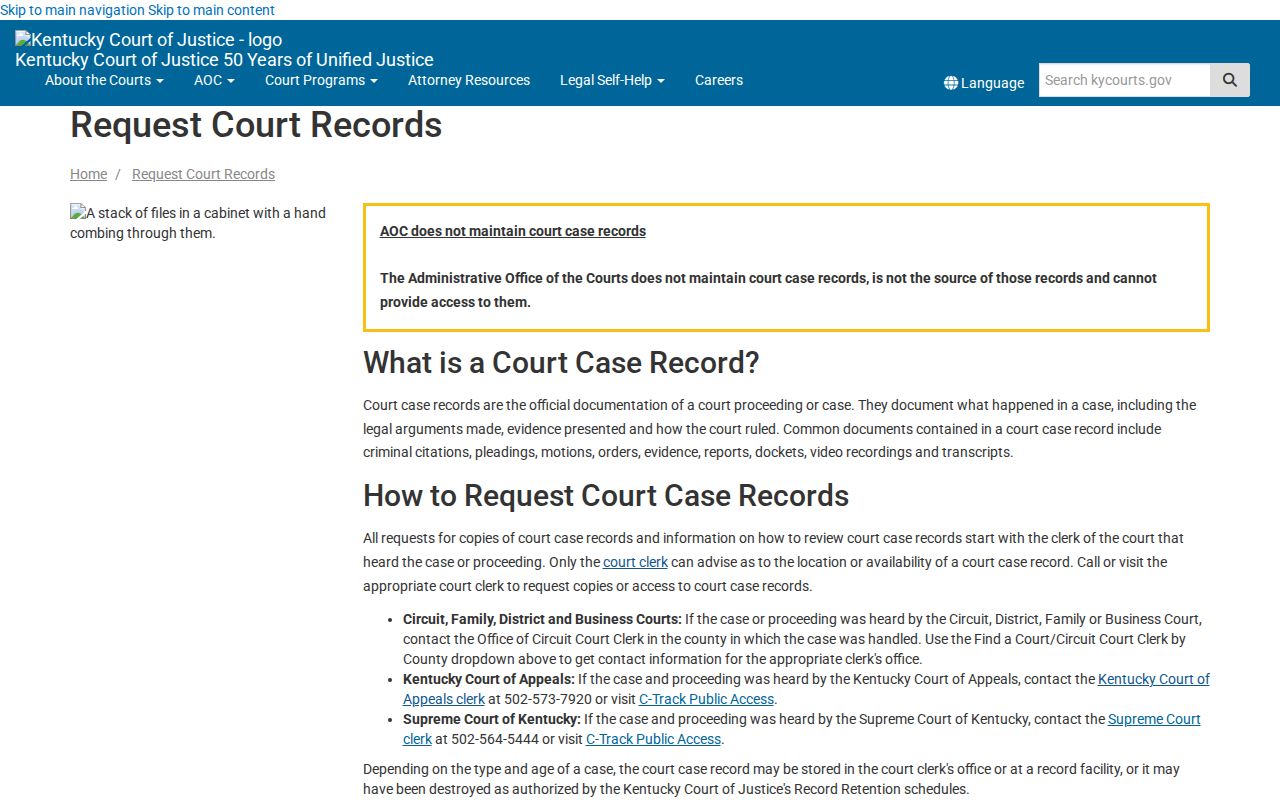
The court channel supplies orders and docket history, but the physical release time still comes from the custodian's booking-release record.
Find a Released Knox County Inmate
Use a custody-specific sequence instead of treating every database as interchangeable.
- Check the official Knox current JailTracker only to determine whether the matching person remains listed. Knox publishes no verified rolling release feed; the 24-hour release guide explains the same-day fallback.
- Search Kentucky VINE for the correct identity and facility. A release or transfer alert should be corroborated.
- Call Knox County Detention Center at 606-546-6215 and ask whether Knox released or transferred the person and, when public, which agency received custody.
- Match the Knox court case and order. The court explains bond, dismissal, sentence, probation, or other authority.
- If the person was state-sentenced, search KOOL by name, DOC number, PID, supervision status, county, or projected release date. Check DOC Daily Releases for an event report.
- For federal or immigration custody, use BOP, the federal docket, the actual USMS housing facility, or ICE ODLS as appropriate.
- If online evidence remains incomplete, request the focused booking-and-release record rather than a broad background history.
A person normally drops from a current roster when that facility's custody ends. The removal alone cannot distinguish community release from transfer, a court-directed event, or a data correction.
Kentucky DOC Search for Released Inmates
The Kentucky Online Offender Lookup, or KOOL, covers people in Kentucky Department of Corrections jurisdiction, including some state-sentenced people housed in county jails. It is not a complete list of ordinary Knox bond releases. Search broadly, then open the detail and reconcile the name, identifiers, conviction county, location, and dates. KOOL updates daily, while newer information may take up to 120 days to finalize.
| Search field | How to use it |
|---|---|
| Name | Try exact and alternate spellings, then confirm other identifiers. |
| DOC number or PID | Use the correctional identifier for a more precise match. |
| Offender type or status | Separate incarcerated, supervised, and other DOC populations where available. |
| County fields | Distinguish county of conviction from county of supervision; they may differ. |
| Projected release range | Find candidates by an estimate, then preserve the exact date label on the detail. |
A detail can show current location, supervision status, sentence information, parole information, and minimum or maximum expiration dates. None should be relabeled as the actual physical release time. The DOC Daily Releases archive provides dated weekday PDFs with DOC number, name, release type, released-from facility, and highest felony class. A report may name Knox County Detention Center, but it covers DOC releases only.
Knox Jail Releases Without a Feed
No distinct official Knox County, Kentucky 24-hour or 72-hour release archive was found. The jail's official entry is a current-inmate list, and neither its update cadence nor post-release retention window is published. Search results often surface Knox County, Tennessee material; it does not belong to this Kentucky inquiry. For a same-day or three-day window, use the jail, VINE, court, and a date-range open-record request. DOC Daily Releases can supplement that work only for state offenders.
Parole and Probation After Release
The Kentucky Parole Board decides parole, while the Department of Corrections Division of Probation and Parole supervises people in the community. A local bond release does not automatically create either status. Search KOOL and inspect Supervision Status, County of Supervision, begin and end dates, and the listed office. Then use the Knox parole and probation guide to reach Eastern Region District 10 in London when confirmation is appropriate.
Do not assume county of conviction equals county of supervision, and do not read a projected supervision-end date as completed discharge. An `ABSCONDED` status reports noncompliance or unknown whereabouts to the supervision authority. It does not prove current jail custody. Check the live custody systems and District 10 before drawing a conclusion.
Knox Reentry Region 8 Resources
Knox falls within DOC Reentry Region 8. Its P&P reentry coordinator covers Laurel, Knox, Bell, Harlan, Leslie, Clay, and Jackson counties. The state also publishes a Knox County community-resource manual. That manual can help a person already served by DOC identify local categories of support, but it dates from 2018 and individual providers should be called before relying on an address, program, or eligibility rule.
Reentry navigation is not the same as custody verification. First establish the person's status and supervising office through KOOL or District 10. Then use the regional contact or resource manual for a service question within DOC's reentry framework.
Release Notifications and Federal Releases
Kentucky VINE permits anonymous web or telephone checks and person-specific notifications for county jail and state custody events. It can alert by phone, email, text, TTY, or app for events such as release or transfer. A notice reflects a participating source's report, not proof that every custody or supervision obligation ended.
For a sentenced federal prisoner, the BOP locator can show a release date and “RELEASED,” no institution, or equivalent not-in-custody wording. “IN TRANSIT” is not release. USMS has no comparable public release locator for federal pretrial custody, so use the federal docket, release order, and actual housing facility. ICE ODLS may show current detainees and people released from ICE custody within the past 60 days. Transfer from Knox to ICE is entry into another custody system.
Knox Released Versus Current Custody
Choose the source that owns the event. Absence in one system should prompt a different custody check, not a conclusion.
| Source | Best use | What absence means |
|---|---|---|
| Knox current roster | Test present listing in the county jail. | Could be release, transfer, correction, or no match. |
| Knox release record | Confirm local release time, type, and receiving agency. | Ask whether another custodian owns the record. |
| Court case | Confirm the order or disposition authorizing release. | May reflect sealing, expungement, access limits, or search mismatch. |
| KOOL and DOC releases | Track a state offender's location, supervision, dates, and release event. | The person may never have entered DOC jurisdiction. |
| VINE | Check or receive participating custody events. | Coverage, identity, or timing may require agency confirmation. |
| BOP or ICE | Check the relevant federal custody system. | Try the court, USMS housing facility, ERO, or another custodian. |
Knox County Release Systems
Knox County Detention Center is the primary local custodian. Kentucky Department of Corrections covers state-sentenced custody and community supervision, even though no adult state prison is located in Knox County. Federal inmate release requires BOP or federal court and housing-facility records. ICE detainee release uses ODLS and ERO channels. The Kentucky released offender registry applies only to people legally required to register and never proves a release date.
No adult Kentucky DOC prison appears in Knox County on the state institution list. A Knox-convicted person may serve a sentence anywhere DOC assigns or may remain in a contract county jail as a state inmate. Use the KOOL location field and a transfer record to identify the real custodian instead of guessing from geography. Likewise, no official source identified the Knox detention center as an ICE detention facility; the ICE route applies only when a documented detainer or transfer makes it relevant.
Preserve the Source and Date
Dynamic custody systems change. Save the system name, exact field label, access date, booking or offender identifier, and the document URL used for a conclusion. A KOOL “Parole Eligibility Date” is not an actual release date. A VINE alert is not a court order. A court order is not the jail's physical departure timestamp. Keeping those distinctions makes later verification possible when a roster changes.
Does a missing name prove release? No. It proves only that a matching entry was not found at that moment. Confirm the identity and ask the originating custodian whether release, transfer, correction, sealing, or another event explains the change.